

Thank you for the free trial of 2026. I wish to unsubscribe.
So far for 2026, my resolution not to doom scroll has not been going too well.
Last year I managed to shift my news addiction and its negative side effects to a more manageable level (think cutting back to social drinking rather than a full scale dry January). I started waking up to ClassicFM rather than the Today programme and seeing the benefits to my heart rate, also eschewed the six o’clock news while cooking dinner for a music playlist and a bit of dancing round the kitchen when the teenager wasn’t looking.
And then came 2026, and with it the daily battering of news stories which seem straight out of a dystopian novel, and I can’t look away. Part of me feels like none of this is real. A cognitive dissonance, like an episode of Black Mirror that I can’t turn off, with the news playing like terrifying addictive entertainment on every social media channel.
I feel overwhelmed, simultaneously having no agency, but also thinking I must be able to do something. My rage is real but also powerless.
This interview with Tim Minchin provides practical advice how to balance keeping informed with wellbeing.
He says that ‘consuming’ the news like this is only ethical if it spurs you to action, otherwise, it becomes just distressing which then affects you and your relationships. He asks us to think about our motivations for consuming the news in this way, and how to be intentional in what we do, and what we can do within our power. `
If, like me, you have trouble keeping things in balance, I recommend taking some time out to take a look at your Circles of Control, Influence and Concern.
When we are driven by a powerful sense of meaning and vocation in our work, establishing healthy boundaries can be a challenge. We can feel responsible, beyond our job descriptions.
In my work with Freedom to Speak Up guardians and culture change ambassadors, I’ve heard how they can feel a responsibility beyond their role. They are tasked with influencing to make a difference, but instead end up feeling the burden of the whole broken system.
Balancing compassion with boundaries
I recently had the privilege of supporting a group of Freedom to Speak Up guardians facilitating a workshop with them looking at how to balance assertiveness with kindness. They wanted to help people move on once a concern had been investigated, but with kindness and empathy. The Circle of Control was a great way to look at boundaries and responsibilities.
Freedom to Speak Up guardians work on the frontline of their organisation’s culture to make speaking up business as usual. But their task may feel monumental, especially if they work in an unsupportive environment.
Over the past six months, I’ve been asking Freedom to Speak Up guardians about their wellbeing in an anonymous survey. I’m curious about how they manage their passion and compassion, how they keep their fire burning, without burning out. (If you are a Freedom to Speak Up Guardian and would like to take part, you can find the survey here)
It is not just that their role is complex, relentless, impactful yet hard to measure. They are also working in complex environments. The NHS, like all workplaces, doesn’t operate in a vacuum; it is a microcosm of the world outside.
But unlike other workplaces, the organisations which make up the NHS really do operate deeply embedded within the society they operate.
All political decisions are felt in the health of the nation. Policies on mental health, crime prevention, immigration, education and social security all impact on the people who show up in A&E. A recent article shows the impact that these policies have on the day-to-day wellbeing of NHS workers – with a horrifying average of 285 attacks on NHS workers each day in 2024-25.
In my survey there are comments from people sharing how rewarding the Freedom to Speak Up role is, how privileged they feel to be able to support and help people, and make a positive impact.
“I love being able to meet with someone who initially is in a dark place but by the end of my time with them they leave more positive, smiling and grateful.”
But guardians are also toxin handlers; and some of the concerns raised with them can bear witness to the darkest edges of human behaviour.
Some guardians talk of a feeling of powerlessness when unable to change the systemic issues which are the cause. For example, global politics, the cost of living crisis, under funding, under staffing, crumbling infrastructure. And some guardians are doing this without the time and resources needed which has an inevitable impacts on guardian wellbeing.
One guardian, overwhelmed by feelings of disappointment and frustration, sent me a poem they wrote to vent their feelings of powerlessness and rage. I am so grateful for their permission to reproduce it here anonymously as it powerfully captures the tension between emotion and professionalism, between speaking up and being heard.
For Those Still Unheard
Tell me, please
When you help them speak up
But they are rarely heard
When you mustn’t judge who’s right
Though there’s wrong being done
When you want things to heal
And there’s only more harm
When your words give people hope
Yet your own is all gone
When you worked hard for change
But it all stays the same
Tell me, please
Where's the freedom in that?
Your Circle of Control
The Circle of Control concept originated from the Stoic philosopher Epictetus. The concept was further developed by Stephen Covey in his 7 Habits of Highly Effective People. It can be a useful tool to help us balance our wellbeing by articulating which things we can influence and control, and which we cannot.
Epictetus was a former slave turned philosopher, and he wrote that the key to peace and freedom lies in focusing only on what we can control and letting go of everything else.
“There is only one way to happiness and that is to cease worrying about things which are beyond the power or our will. ”
― Epictetus
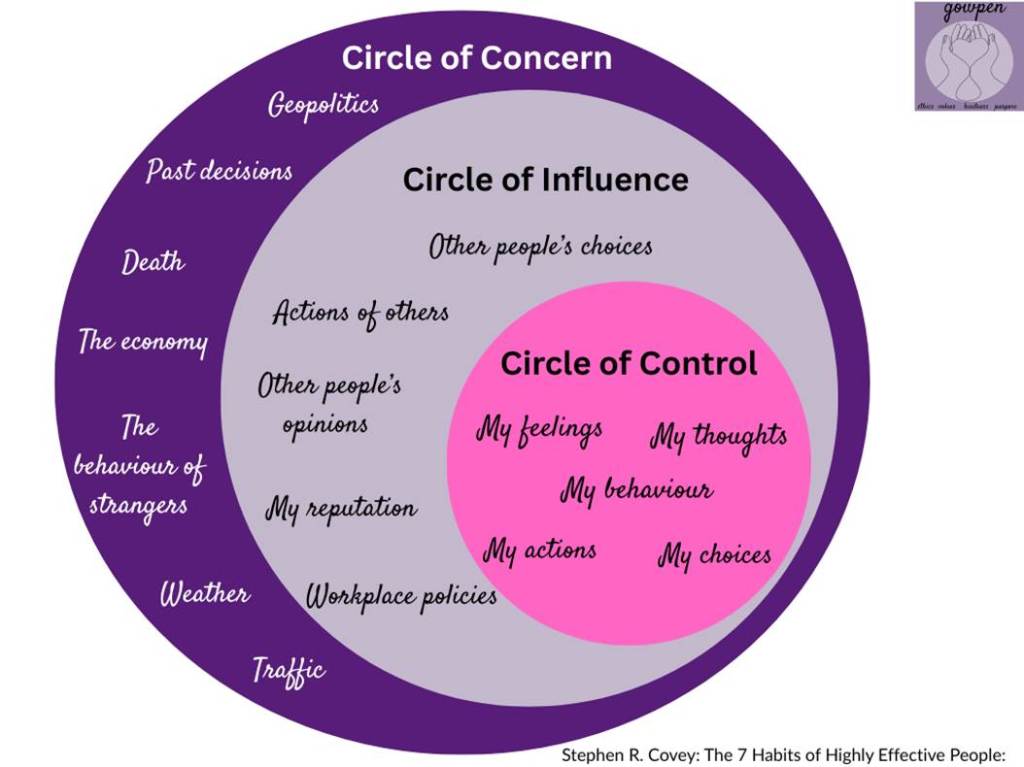
Start by listing all the things that are currently concerning you, but that you feel stuck or overwhelmed by.
Take a look at your list, then put your concerns into the different circles:
In the centre is what you can control – your thoughts, feelings, beliefs, your behaviour
This is your Circle of Control.
Beyond that, the second circle in the Circle of Influence. This is the grey zone. You may not have the power to change things in this circle, but you can try and influence them. For example, talking to leadership about funding for a project; facilitating mediation between two individuals; communicating the importance of speaking up and listening up to a group of managers. You may not be successful. You can control your effort, but not the outcome.
And beyond that is the Circle of Concern. These are the things we care about, but we cannot control. From global politics – the wars in Gaza, Ukraine, the latest announcement by the President of the United States – to the economy, the weather, things that happened in the past.
Look at what is within your Circle of Control. It’s a much smaller list than when you listed all of your concerns. It is your words, your actions, your behaviour.
If we neglect these elements, this can lead us to feel disempowered. Instead of taking ownership of our behaviour, we fall into complaining, blaming others, thinking of ourselves as passive and without agency.
How can you focus more on what is in your control?
How can you use what you can control to change things for the better, by influencing colleagues, family and friends? By taking responsibility for the impact of what we think, say and do, we can respond rather react, knowing that we are using our power in our Circle of Control.
When we feel angry, powerless, frustrated, helpless it can be as a result of trying to change things which are not within our sphere of influence. That can be when we end up hitting passion fatigue.
Letting go of what is beyond our power doesn’t mean we stop caring about it. It helps us to understand what we can influence and how.
In this way we can use our energy more effectively to make a difference.
At Gowpen, we help you bridge the gap between ethical business practice and wellbeing.
View our full range of services including Freedom to Speak Up support, Critical Friend service, board development or values and culture workshops
If you found this Circle of Control exercise of value, it is included in the wellbeing workbook I have developed for Freedom to Speak Up guardians
Use the code HAPPY2026 at the check out to claim your discount in January.
 Gowpen