

Maybe nobody cares about ethical values anymore.
That’s what I found myself thinking as I cleaned the kitchen worktop. (Life hack: it’s one of the ways I do my thinking).
Sometimes talking about ethics gets dismissed as virtue signaling or empty corporate rhetoric – ‘laminated values’ rather than lived. Business ethics tends to drift in and out of fashion, until the next major integrity crisis forces values back to the top of boards’ and regulators’ agendas.
I don’t really believe that, I thought, as I moved on to emptying the dishwasher.
But somewhere, in between HR, Internal Communications and Ethics/Compliance/Governance functions, it feels that communicating ethical values at work falls down the metaphorical cracks. And the messaging along with it.
Like this scene from the Office (US) https://youtu.be/cb5DITStXlI?si=55FrOaaQB7KeZOD2

The reality is that each and everyone of us – managers and colleagues – communicates ethical values at work. Although these may not be the espoused values on the company website.
Communicating ethical values and behaviours is complex, because it’s not simply a matter of sign posting, ticking the box marked ‘understood’ after completing mandatory training. Values are personal. And corporate values – the values we proport to share in working together at an organisation, they are to be lived not ‘communicated’.
But if your role – whether that’s as communicators, ethics officers, or Freedom to Speak Up guardians – relies on people understanding what is expected of them, then we need to take some responsibility for making sure that those standards and values are communicated and understood.
The Cultural Web
Whenever groups of people come together, we form a culture, a messy tangle of values, beliefs and behaviours which are the unwritten language of how the group operates. This is as true of a family, a team, a business or an institution.
Johnson and Scholes (1992) mapped this into the Cultural Web, a model for looking at all the threads which make up the fabric of organisational culture.
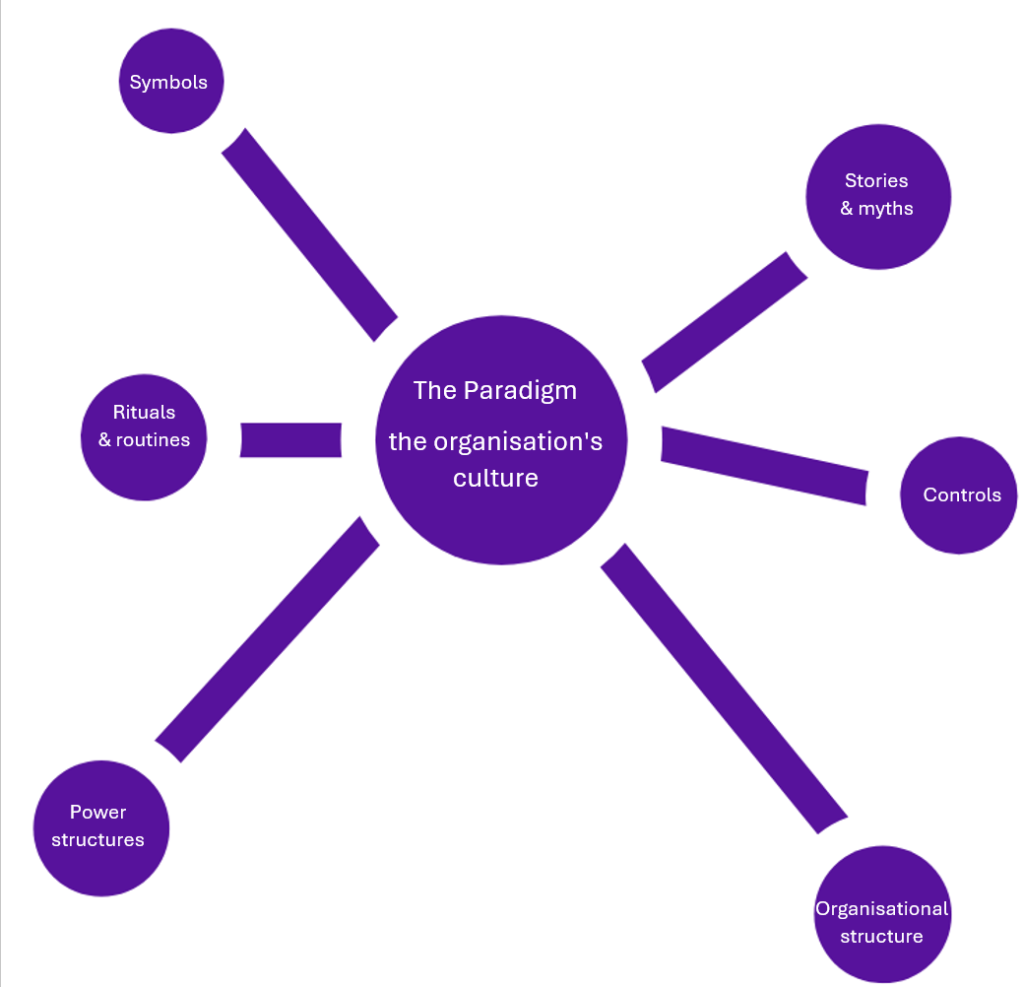
At the centre of the web is the paradigm: the core identity of what the organisation is about – what it does; its mission; its values. And around it are the six elements which determine this paradigm. All these elements need to be aligned with ethical values for the organisation to operate ethically.
The six key elements which weave around the core paradigm and influence it are:
Stories and myths – the narratives, myths, and legends that are shared within the organisation
Symbols – the physical artifacts, logos, dress codes, and other visual representations
Rituals and routines – the repetitive practices and behaviours that characterise the organisation, like meetings, celebrations and decision-making processes
Power structures – the formal hierarchies and the informal influences (who has real say)
Organisational structure – not just the formal structure of the organisation, departments and reporting lines, but also the the informal networks and relationships
Controls – the systems and processes used to manage conduct and ensure compliance.
More mycelium than a model
The model of the Cultural Web can be used to identify strengths and weaknesses in an organisation’s culture, and how they are being communicated and by whom.
The model of the Cultural Web looks much less messy than the reality, which would look more like a mycelium network than a powerpoint presentation. The Wood Wide Web is the an underground web of tiny fungal threads called hyphae that connect plants and trees across a forest in a mycorrhizal network, communicating invisibly.

Just so with organisational culture – the invisible web of relationships, symbols, and daily rituals are what sustain the ethical ecosystem – whether that’s in a positive or a negative way.
And stories spring up like mushrooms.
The role of stories
I have long been advocating for more stories to be used to communicate values and expectations at work.
That’s because as humans we are story-telling creatures. We are raised by stories, it is how we come to understand the world and our place in it.
It is where we first learn about values – in those bedtime stories, those family stories, which tell us so much about the culture we are growing up in. They tap into the meaning making, emotional side of our brains.
“Stories define who we are, what we do, and why and how we do it”.
Joseph Campbell
And, as the Cultural Web illustrates, they continue doing that at work.
So I don’t really believe that nobody is communicating ethical values.
Because throughout our organisations there are stories about ethics every day.
Who gets promoted, who not to be alone in the office with, how to by-pass that ‘time-wasting’ control. Stories about what happens if you speak up, and what happens if you mess up. Stories about why people left, why people are still there, who moved and why. Who are the heroes. Who are the villains. This isn’t office gossip, it’s the mycelium network of your organisational culture.
And sometimes, those stories may be out of date. Second, third hand. Changed in the telling, from reality, to myth.
Listening to the stories we tell
What do the stories in your organisation tell you about the culture?
Communications is as much about listening as it is about broadcasting. Here are some questions to ask about the stories in your organisation.
- How do we talk about each other? Whether that’s within our team, cross-teams, between departments or as an organisation
- How do we talk about customers, patients, stakeholders? How do we see them, discuss them? Would they recognise themselves in these stories? How might they tell them differently?
- How do we talk about leaders? What stories shape how we talk to and about authority?
- Which stories get repeated again and again?
What are the themes of these stories? Are there common characters or events?
What do these stories say about what’s important to us? - What don’t we talk about? What is off-limits, or silenced?
- Whose stories do we listen to? And whose are we not hearing?
- How do we talk about the past, the present, and imagine the future?
Changing the narrative
You may want to change the narrative.
You may want to change old behaviours, ways of working from another era, to communicate what your organisation’s values mean now. What it means to work here.
The only way really to communicate ethical values, is by showing what you are doing. Actions, after all, speak louder than words.
Do you have a story to tell about how your organisation is changing, and why? How people speaking up in your organisation are helping bring about a change of narrative. And the learning which is happening as a result.
Can you help with my research?
If you’re working with people, culture, or communications, I really need your help.
Building on my previous work with the Institute of Business Ethics, I have been commissioned as part of the CIPR research fund to look at how ethical values are communicated.
As part of this research I’d really value your input by filling in a short survey: https://forms.gle/rPJvbyxMiELtnQYm6
And If you’d like help in communicating your ethical values, whether that’s in gathering stories from your people, or brainstorming a strategy, or as a sounding board, please get in touch.
 Gowpen